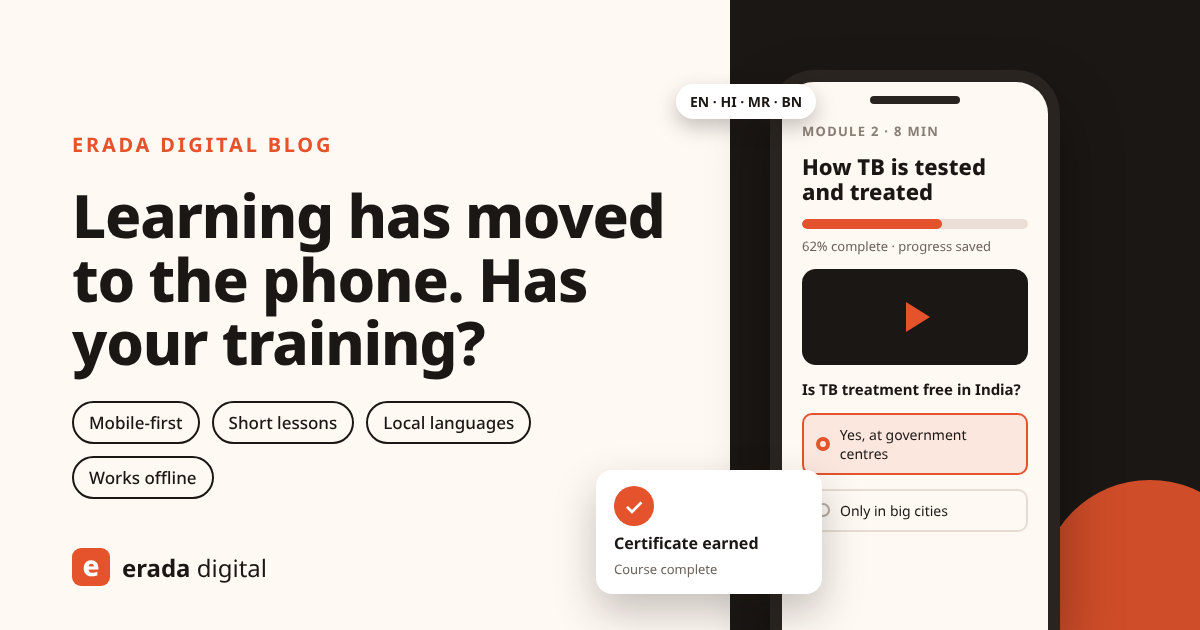
Learning has moved to the phone. Has your training?
Think about the last time someone in your team learned something new for work. Chances are it didn’t happen in a classroom. It happened on a phone, in a few spare minutes, perhaps on a bus or between field visits.
Most training in NGOs and public-health programmes is still designed the old way: a long workshop, a thick handout, a PowerPoint shared as a PDF afterwards. These still have their place, but they’re expensive to repeat and hard to measure, and much of what was taught is forgotten within weeks.
A modern learning platform changes that. Here’s what “modern” actually means today, and what to look for if you’re planning online training for your staff, volunteers or community.
1. Designed for the phone first
For most learners in India, the phone is the computer. A course that looks fine on a laptop but needs pinching and zooming on a phone will lose people in the first five minutes.
Mobile-first means large buttons, short screens, one idea at a time, and navigation that’s always within reach of a thumb. It also means pages that load on a basic data connection, not just on office Wi-Fi.
2. Short lessons, not long lectures
People learn better in small pieces they can finish. A good module takes 10 to 30 minutes and is split into short sections, each with one clear point. Learners can stop and pick up where they left off, because the platform saves their progress.
This suits real working days. A health worker can finish one section during a break and the next one in the evening.
3. Learning by doing, not just reading
Reading slides isn’t the same as understanding. Modern courses mix short explanations with things the learner does:
- Myth-or-fact cards that challenge common beliefs
- Sorting games and drag-and-match activities
- Real-life scenarios where the learner makes a choice and sees what happens
- Short quizzes with instant, friendly feedback
These are more engaging, and they show whether the message has actually landed.
4. In the learner’s own language
Training in English alone leaves out a large part of the people who most need it. A modern platform lets the same course run in several languages, with the learner choosing theirs on the first screen. Translation still needs care: health terms, programme names and helpline details must be checked by people who know both the language and the subject.
5. Works with weak or no internet
Field teams don’t always have a signal. Platforms such as Moodle offer a mobile app that can download a course and let people learn offline, then sync their progress later. For programmes working in remote districts, this can decide whether training reaches people at all.
6. Proof of learning, not just attendance
A modern learning management system (LMS) records who enrolled, who finished, how they scored and where they got stuck. Learners get a certificate when they complete a course, and managers get reports by district, role or batch without chasing anyone for registers.
That data also shows which topics are hard to understand, so the course can be improved over time.
7. Standards, so content isn’t locked in
Courses built to open standards such as SCORM can move between platforms. If your organisation changes its LMS, or a partner wants to run your course on theirs, the content still works. Building on well-supported, open tools also means your team, or any future vendor, can keep it running.
Where to start
You don’t need a big budget to begin. A practical first step looks like this:
- Pick one training you repeat often, such as staff induction, a refresher or community awareness.
- Cut it into short modules, each with one clear goal.
- Add activities and a short quiz to each module.
- Test it on a basic phone, with real users, before launch.
- Measure completion and quiz scores, and improve the weak parts.
See it in action
We’ve put this approach into practice on our own learning platform, which hosts free courses for the public on HIV and TB. They are written in plain language, built for phones, available in English, Hindi, Marathi and Bengali, and checked against official sources.
👉 Try a free course on Erada Learning
If your organisation wants a learning platform of its own, or wants existing training turned into interactive online courses, tell us what you’re trying to achieve.